
 Switch
 Homepage
 facebook
 IG
IG
 Other Hospital
 CMUH App
Laboratory Medicine | About Us
About Us
In response to disease diagnosis, therapeutic monitoring, and disease prevention, clinical laboratory testing has become an indispensable component of modern medical practice. By applying laboratory science methodologies, clinical testing provides objective and quantitative data or reports that reflect patients’ physiological conditions, thereby offering crucial medical evidence for confirmation, exclusion, guidance, and monitoring in patient care.
With continuous advances in medical technology, increasing patient demands, and progressively higher expectations for quality, rapid developments in testing technologies have greatly expanded the scope of clinical laboratory applications. In addition to traditional testing areas and services—such as routine examinations of liver function, renal function, blood, and urine—molecular diagnostics and precision medicine–related tests have gained increasing importance. These include genetic testing for cancer susceptibility, cancer risk genes, cerebrovascular and cardiovascular disease risk genes, as well as nucleic acid testing for SARS-CoV-2. By integrating emerging fields such as bioinformatics, these advanced technologies are gradually being applied and incorporated into clinical laboratory testing, enabling the provision of more personalized clinical laboratory services.
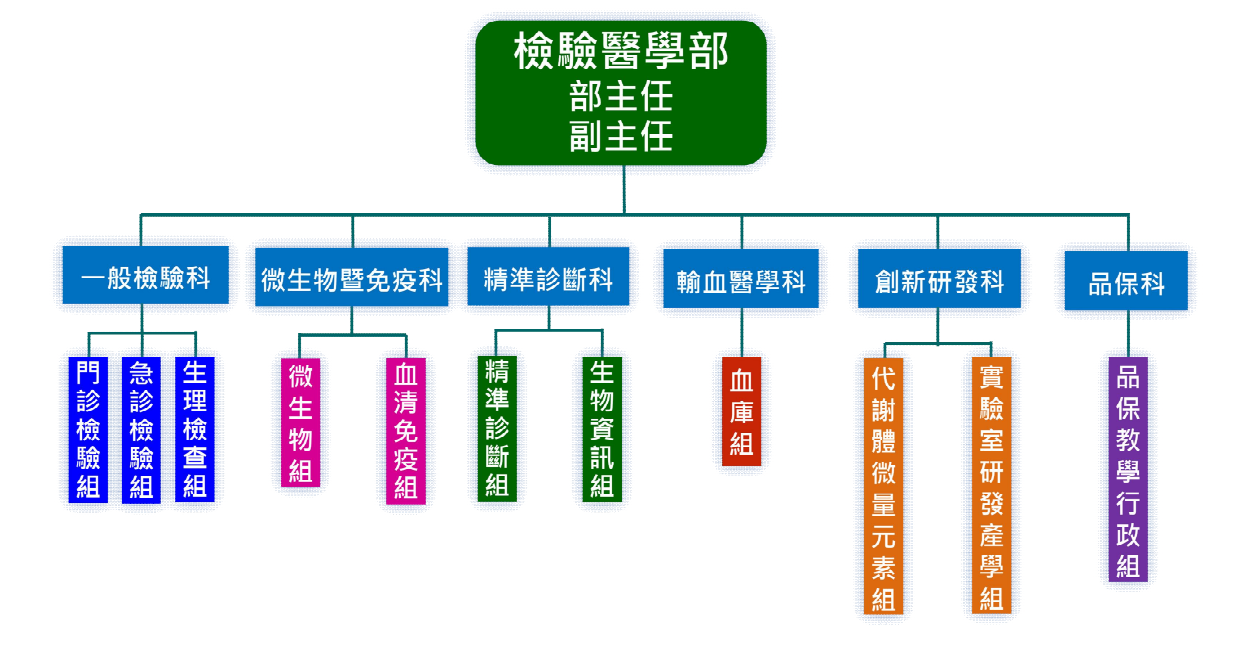
The Department of Laboratory Medicine currently comprises six divisions: General Laboratory, Microbiology and Immunology, Precision Diagnostics, Transfusion Medicine, Innovation and Research & Development, and Quality Assurance. Each division is led by a specialist physician or a senior medical laboratory scientist serving as division director. Together, they are responsible for planning, promoting, and managing the development of laboratory services, education, and research.
Under these divisions, the department operates elevent functional sections, including Section of Outpatient Service Laboratory, Section of Emergency Service Laboratory, Section of Physiological Examination (EKG), Section of Microbiology, Section of Serology and Immunology, Section of Precision Diagnosis, Section of Bioinformatics, Section of Blood Bank, Section of Metabolomics and Trace Elements, Section of Industry-academia Research and Development, and Section of Quality Assurance, Education and Administration. These sections are coordinated by technical supervisors who oversee the execution of laboratory operations and the control of testing quality and technologies.
The department primarily serves patients and physicians of this hospital, supports specialized laboratory testing for affiliated hospitals within the healthcare system, and assists hospitals and clinics of all levels in the central region through referral and outsourced testing services. In addition, the department implements observation and internship training programs for students from relevant university departments, and accepts applications for visits and advanced training from domestic medical institutions as well as international academic and healthcare professionals.
Other important services of the department include supporting or leading various international clinical trials, as well as conducting industry–academia collaboration projects and clinical research in partnership with biotechnology companies. From round-the-clock blood bank and emergency laboratory operations to routine health examination tests; from transplantation-related testing to personalized genetic testing; and from product validation and evaluation for biotechnology companies, the scope of services is extensive. The core values guiding overall operations and management are professionalism, accuracy, timeliness, and safety. All staff members work collaboratively to provide comprehensive and high-quality laboratory services, cultivate outstanding laboratory professionals, and uphold the mission of ensuring laboratory and patient safety.
In 2011, the department collaborated with the Children’s Medical Center and National Chiao Tung University to apply MALDI-TOF (Matrix-Assisted Laser Desorption Ionization Time-of-Flight) technology for the identification of variant hemoglobin amino acid sequences. In the same year, the department published research in an international scientific journal demonstrating the effectiveness of High-Resolution Melting (HRM) analysis for the differential diagnosis of β-thalassemia genotypes. This innovative integration of molecular diagnostic principles and advanced technologies was recognized in 2011 with the National Quality Award (Symbol of National Quality) by the Institute for Biotechnology and Medicine Industry, under the title “The Guardian Team for Thalassemia and Hemoglobin Gene Disorders.”
 Facebook
 IG
IG
 YouTube